Series: How to Read a Bond Indenture — A Value Investor’s Framework
Introduction
When investors say a bond is “senior,” they usually stop thinking right there.
That is a mistake.
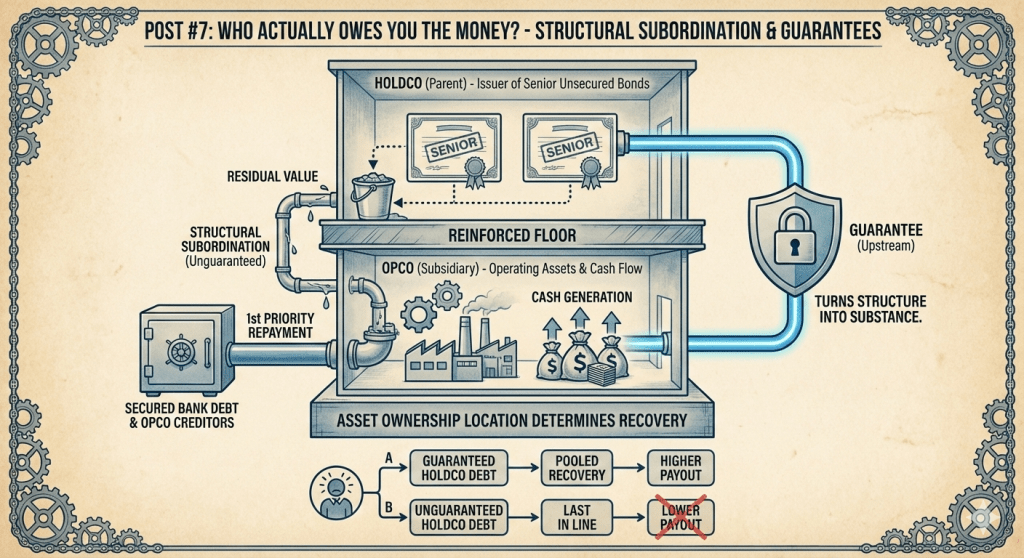
In modern corporate structures, legal seniority does not determine recovery.
Structural position does.
Two bonds can both be labeled senior unsecured yet one recovers 70 cents on the dollar in distress, while the other recovers 10. The difference is not credit quality. It is where the bond sits in the corporate architecture.
This post explains how guarantees, subsidiaries, and structural subordination determine who truly owes you money and who gets paid first when things go wrong.
1. Legal Seniority vs. Structural Seniority
Let’s establish the key distinction.
Legal Seniority
- Defined within the same legal entity
- Senior > subordinated > equity
- Applies only inside one balance sheet
Structural Seniority
- Determined by where the debt is issued
- Depends on:
- Parent vs subsidiary
- Operating company vs holding company
- Asset ownership location
In bankruptcy, cash flows upward, not sideways.
Whoever sits closest to the assets gets paid first — regardless of legal labels.
2. Holding Company vs Operating Company (The Core Trap)
Many public companies are structured as follows:
- HoldCo (Parent):
- Issues public bonds
- Owns equity in subsidiaries
- Has no operations
- OpCo (Subsidiary):
- Owns assets
- Generates cash flow
- Employs workers
- Often issues bank debt
If you own HoldCo debt and the OpCo issues secured or senior debt, you are structurally subordinated, even if your bond is labeled “senior.”
Why This Matters in Distress
In bankruptcy:
- OpCo creditors are paid first from OpCo assets
- Only residual value flows to HoldCo
- HoldCo bondholders fight over what’s left
This is why:
Senior unsecured HoldCo debt can recover less than secured OpCo debt even when issued by the same corporate group.
3. Guarantees: Turning Structure Into Substance
A guarantee legally obligates another entity to repay the debt if the issuer cannot.
Guarantees collapse structural distance.
Types of Guarantees
Upstream Guarantee
- Subsidiary guarantees parent debt
- Strong protection for bondholders
- Pulls operating assets into recovery pool
Downstream Guarantee
- Parent guarantees subsidiary debt
- Common
- Less helpful for HoldCo bondholders
Cross-Guarantees
- Multiple subsidiaries guarantee each other
- Typical in leveraged credit
- Improves recovery consistency
Strong vs Weak Guarantee Language
Strong guarantees:
- Are unconditional
- Are joint and several
- Survive restructuring
- Cover all payment obligations
Weak guarantees:
- Are limited
- Can be revoked
- Exclude certain subsidiaries
- Terminate upon asset sales
Always verify:
Which legal entities are guarantors and which are excluded.
4. Non-Guarantor Subsidiaries: Where Value Leaks
One of the most dangerous phrases in an indenture is:
“Certain subsidiaries are designated as non-guarantors.”
This allows:
- Assets to sit outside the creditor pool
- Cash flow to bypass bondholders
- Value to be structurally isolated
Common Justifications
- Foreign subsidiaries
- Regulated entities
- Joint ventures
Credit Reality
Non-guarantor subsidiaries often:
- Hold profitable assets
- Generate stable cash flow
- Remain untouched in restructuring
Bondholders then discover:
The assets they thought backed the bond legally never did.
5. Structural Subordination in Practice
Let’s compare two simplified structures.
Structure A- Guaranteed Debt
- Parent issues bonds
- All operating subs guarantee
- Assets pooled
- Unified recovery
Structure B- Unguaranteed HoldCo Debt
- Parent issues bonds
- OpCos issue bank debt
- No guarantees
- Bondholders rely on dividends
In distress:
- Structure A bondholders participate in asset recovery
- Structure B bondholders are last in line
Same issuer. Same coupon. Same rating.
Completely different outcomes.
6. Why Ratings Often Miss Structural Risk
Ratings agencies:
- Focus on consolidated financials
- Assume capital fungibility
- Underweight legal entity separation
But bankruptcy courts do not consolidate by default.
Recovery depends on:
- Entity-by-entity balance sheets
- Intercompany claims
- Guarantee enforceability
This is why sophisticated credit investors:
Read the legal structure before reading the income statement.
7. Real-World Pattern: Why Bank Debt Always Wins
Banks insist on:
- OpCo issuance
- Asset liens
- Guarantees
- Covenants controlling asset movement
Public bondholders often accept:
- HoldCo issuance
- No guarantees
- Broad subsidiary exclusions
This is not accidental.
It reflects negotiating power, not risk neutrality.
8. How to Read This Section of an Indenture
When reviewing guarantees and subsidiaries, identify:
- Issuing entity
- List of guarantors
- Non-guarantor subsidiaries
- Conditions under which guarantees can be released
- Whether future subs must guarantee
- Whether asset sales terminate guarantees
- Whether guarantees survive mergers
Ask one blunt question:
Do I have a legal claim on the operating assets or only on dividends?
9. Value Investor Interpretation
Structural subordination explains why:
- “Senior” bonds still suffer large losses
- Recovery estimates vary wildly
- Two bonds from the same issuer trade at different yields
For the value investor, guarantees are not legal formalities they are the difference between credit and speculation.
If you are not guaranteed by the entities that generate cash, you are not underwriting a business you are underwriting organizational goodwill.
Conclusion
Credit losses are rarely caused by bad math.
They are caused by bad structure.
Understanding guarantees and subsidiaries allows you to:
- See through misleading seniority labels
- Estimate real recovery value
- Avoid structurally junior traps
- Demand yield for hidden risk
This is where bond analysis stops being academic and becomes defensive capital allocation.
Next in the Series
Post #8 — Events of Default, Acceleration & Trustee Powers: What Actually Happens After a Breach
We’ll cover:
- Payment vs covenant defaults
- Cure periods
- Acceleration mechanics
- Trustee limitations
- Why many defaults don’t lead to immediate recovery

 BargaInvest Capital
Leave a reply to Anonymous Cancel reply