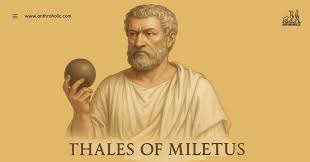
1) Thales’ Lesson from 2,500 Years Ago
2,500 years ago, Thales of Miletus noticed something others didn’t: a bumper olive harvest was coming. Farmers saw the same weather, soil, and tree conditions but thought it ordinary. Thales saw it as inevitable.
He acted on his insight because he thought he had an edge over the sellers. He reserved olive presses months before the harvest. The sellers saw a small premium, but they didn’t see what he saw: a harvest that would create scarcity and value.
When the harvest came, Thales controlled the one thing everyone needed. He made a fortune. His insight correctly interpreted and timed the event, creating enormous asymmetry between what he paid and what he earned.
Lesson: Profits come from seeing what others overlook and acting decisively. The size of the profit is proportional to the clarity of your insight and the magnitude of the opportunity.
2) Thales’ Edge vs. Seller Perception
Thales’ advantage wasn’t more data; it was accurate interpretation. He recognized a disconnect between perception and reality. The sellers saw little risk and sold him future rights for a premium. Thales saw that the sellers were not pricing event risk accurately.
Modern options work the same way. Buyers and sellers look at the same information, but only one sees a disconnect between price and reality. Profits go to whoever understands the truth more accurately.
- Buyer: Pays for optionality — the right to capture upside if their insight is correct.
- Seller: Collects a premium, willing to accept the possibility of a large loss.
3) 2500 years later
Fast Forward to Today: Black–Scholes
The Black–Scholes model is the framework for pricing options. Elegant and widely taught. However, it’s a simplification of complex reality and I simply do not subscribe to it. I use it to gauge the temperature of people’s future expectations.
At its core, it calculates an option’s fair value based on:
- Current stock price
- Strike price
- Time until expiration
- Volatility (expected future swings)
- Interest rates
Call option formula (intuitive view):
Call price = current value of expected upside − discounted strike cost
It gives a baseline “fair value,” helping traders see if an option is “cheap” or “expensive.” But markets are messy: stocks jump, volatility spikes, and timing often misaligns with an option’s life. Profits still come from insight into the underlying reality, just like Thales understood the olive harvest.
For a call option, the formula is:
C = S * N(d1) - K * e^(-r * T) * N(d2)
d1 = [ ln(S / K) + (r + (σ^2)/2) * T ] / (σ * sqrt(T))
d2 = d1 - σ * sqrt(T)
Variables:
C= Call priceS= Stock priceK= StrikeT= Time to expirationr= Risk-free rateσ= VolatilityN(x)= cumulative standard normal
- S⋅N(d1)S \cdot N(d_1)S⋅N(d1) = present value of the expected upside if the stock moves favorably
- K⋅e−rT⋅N(d2)K \cdot e^{-rT} \cdot N(d_2)K⋅e−rT⋅N(d2) = present cost of exercising the option at expiration
- For a put, the logic flips: you are buying insurance against a decline in the underlying.
Assumptions baked into the model:
- Prices follow a continuous, smooth path no gaps or jumps.
- Volatility (σ\sigmaσ) is constant.
- No dividends (or they are adjusted separately).
- No transaction costs or taxes.
- Markets are frictionless, liquid, and rational.
These assumptions make the math clean but don’t always match reality. Real markets jump, volatility spikes, and liquidity dries up.
Why Black–Scholes still matters:
- It gives a baseline “fair value” for options.
- Traders can compare market prices to this baseline to see if an option is “cheap” or “expensive.”
- It introduces the Greeks Delta, Gamma, Vega, Theta which describe how sensitive the option is to underlying changes, volatility, and time decay.
Modern usage:
- Quants and trading firms expand on this model with complex algorithms.
- They account for volatility surfaces (different implied volatilities across strikes and expiries), interest rate curves, cross-asset correlations, and fleeting arbitrage opportunities.
- Humans can rarely act fast enough to capture these tiny inefficiencies profits here come from speed, computation, and scale, not insight into the underlying company or event.
Bottom line: Black–Scholes is elegant math, use it to see what people think the future is against your own view of the future. It helps frame the problem, but profits do not come from memorizing formulas. Profits come from understanding the underlying economic reality, just like Thales understood the olive harvest, and knowing how to exploit asymmetry in a market where the seller often holds the advantage.
4) The Greeks, Simplified
Think of Greeks as measurement tools showing how sellers are pricing the future:
- Delta: Option price movement per $1 move in the underlying.
- Gamma: Rate of Delta change.
- Vega: Sensitivity to volatility.
- Theta: Daily loss due to time decay — the cost of renting the opportunity.
Greeks reflect expectations about the underlying, not the other way around. Theta works against the buyer every day, whether your thesis is right or not. Understanding Greeks is helpful, but profits don’t come from them alone.
5) Practical Example: SoundHound
(Note: The numbers below are illustrative the story and the insights are real.)
I identified SoundHound as a company with cutting-edge voice and AI technology. My thesis: within a year, they would sign contracts with car manufacturers and other partners, materially increasing company value.
I bought the stock and call options at a $12 strike, far above the current stock price of $4.40, paying $2.50 per share. I bought 10 contracts, controlling 1,000 shares.
Why this worked, Thales-style:
The market was pricing options based on past volatility, not accounting for the future contracts the company might sign. I bought options at what I considered to be throwaway prices relative to my view of the future. The key was that I had to be correct about both the outcome and the timing before the options expired. I will admit that if the AI boom was not happening in real-time I would have been wrong about timing.
6) Why Someone Buys and Why Someone Sells
An option exists because two parties see the future differently.
- Buyer: Bets on a potential move, paying for asymmetric exposure with limited loss.
- Seller: Collects the premium, taking on a potential liability if the buyer’s thesis is correct.
Most sellers are institutions with data, models, and hedges. They aim for small, consistent profits while occasionally giving up large payouts. This is why the game mathematically favors the seller.
7) Asymmetry in Practice
Optionality magnifies both upside and downside. Example:
| Position | Cost | Stock drops 10% | Result | % Loss |
|---|---|---|---|---|
| 100 shares | $10,000 | 90 | -$1,000 | -10% |
| 1 Call option | $1,200 | 90 | ~$400 | -67% |
Lesson: Timing is embedded in your thesis. A correct prediction with the wrong expiration is like Thales reserving presses six months too early the opportunity has a natural season.
8) Theta and Timing
Theta measures the daily cost of holding an option. It is inseparable from timing — the window in which your insight should materialize.
- Buying a 1-month call for $12 at a $100 stock:
- Week 1: Stock rises $2 → option gains partially.
- Week 3: Stock rises another $2 → closer to break-even, but time lost to Theta.
- Near expiration: Small moves add very little.
Key takeaway: Align your option expiration with your thesis window. Otherwise, you’re paying rent without a chance to profit.
9) Volatility — Expectations vs. Reality
- Implied volatility is the market’s view of future movement baked into the option price.
- Buying options in a calm market = cheap, risky if nothing happens.
- Buying in high volatility = expensive, upside limited if predicted event doesn’t occur.
Premiums encode market expectations, but outcomes may differ. Your edge is seeing mispricing.
10) Optionality is a Lever, Not a Free Lunch
- Options magnify outcomes: upside and downside.
- Sellers collect rent; buyers pay for their thesis.
- Real-world example: $10 option controls $100 of stock — small misstep, and premium is gone.
The market is zero-sum: every gain is someone else’s loss. Profits come from insight, timing, and asymmetry, not memorizing formulas.
11) Thales Checklist for Options
- Edge first: What do you see others don’t?
- Timing second: Does expiration match your thesis window?
- Cost third: Premium = price of participation, not free upside.
- Counterparty awareness: Sellers often hedge, have data, algorithms.
- Greeks as tools: Theta = daily rent. Delta/Gamma/Vega = sensitivity, not guaranteed profit.
Key insight: Buying options amplifies both your insight and your timing risk. Even if your thesis about a company or event is correct, an external shock like a sudden market crash, regulatory change, or macro surprise will prevent your option from paying off. This is the fundamental difference from owning the stock outright: with shares, your thesis can still play out over a longer horizon, but with options, you are on a clock.
Buffett’s idea applied: Options and derivatives are like “ticking time bombs.” Their value is extremely sensitive to timing, and the clock can run out before the underlying thesis is realized. The only way to profit consistently is to combine true insight matched with correct timing.
I REPEAT: Profits comes from seeing what others don’t, betting selectively, and respecting the clock. If you fail to account for timing or shocks, even perfect insight will lose money.

 BargaInvest Capital
Leave a reply to quirkymindfully1b754054b1 Cancel reply