What Is Risk? The Story That Shows It All
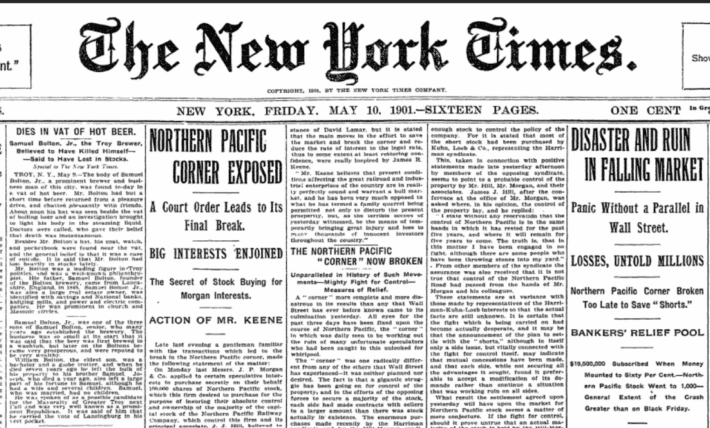
In May 1901, something extraordinary and terrifying happened in the stock market.
Two railroad titans, James J. Hill and E.H. Harriman, were secretly buying shares of Northern Pacific Railway. Each ended up controlling over half the company’s stock.
The battle to corner the stock pushed the price from about $170 to nearly $1,000 in a single day. Short sellers betting the price would fall were crushed by margin calls. Panic buying sent prices soaring even higher.
The chaos destroyed fortunes. One brewer in Troy, New York, overwhelmed by losses, tragically ended his life by jumping into a vat of hot beer.
This wasn’t a small market hiccup. It was a fat-tail event, a rare and devastating blow-up no model or formula could have predicted.
That is what real risk looks like.
Common Measures of Risk: What They Tell You and What They Don’t
In finance, risk is often boiled down to a few numbers:
Beta measures how much a stock moves relative to the market. Above 1 means more volatile, below 1 less.
Sigma (Standard Deviation) shows how “bumpy” a stock’s price ride has been. A higher sigma means wild swings, a lower sigma means smoother.
Value at Risk (VaR) asks, “What’s the worst loss I can expect with X% confidence?” For example, a 5% one-month VaR of $1,000 means there’s a 95% chance you won’t lose more than $1,000 in a month.
Sharpe Ratio measures return per unit of risk. Useful for comparisons but doesn’t tell you the nature of the risks themselves.
Here’s the problem: all these measures are backward-looking. They rely on history how prices behaved in the past to estimate risk in the future.
But price alone doesn’t tell the full story. The real risk lies in structural changes inside the business: the economics, competition, customer habits, management quality, and industry shifts. Price swings alone don’t show whether a company is getting stronger or weaker underneath.
Understanding Risk vs. Uncertainty
Economist Frank Knight drew a distinction. Some things we can measure, others we cannot.
| Known Outcomes | Unknown Outcomes | |
|---|---|---|
| Known Variables | Routine Risk – like dice odds or insurance premiums. | Blind Spots – you think you understand, but hidden factors sneak up, like a rusting bridge. |
| Unknown Variables | Calculated Uncertainty – unknowns you can model, like a startup in a new market. | True Uncertainty – Black Swan events like pandemics or revolutions that rewrite the rules. |
Risk vs. Uncertainty — and the Reflexive Nature of Reality
Frank Knight first made a crucial distinction.
- Risk exists when outcomes are unknown but probabilities are known. Like rolling dice or pricing an insurance policy.
- Uncertainty exists when both outcomes and probabilities are unknown. You can’t even assign odds.
But George Soros took the concept further. He argued that in markets and in life uncertainty is not simply about ignorance. It’s about interaction.
Soros’s Deeper Distinction
Soros introduced the idea of reflexivity:
“Participants’ views influence the situation, and the situation in turn influences participants’ views.”
In other words, when we act on our beliefs, we change the reality those beliefs were about.
Unlike the natural sciences, where the laws of motion or gravity are independent of human perception, markets and societies are reflexive systems they bend when people act.
A risk-based model assumes the underlying structure is stable and measurable. But in a reflexive world, our very attempt to measure risk changes it.
Risk is a Closed System; Uncertainty is Open-Ended
| Feature | Risk | Uncertainty (Reflexivity) |
|---|---|---|
| Structure | Fixed, stable | Fluid, evolving |
| Variables | Known and measurable | Shifting and self-referential |
| Behavior | Predictable over many trials | Feedback-driven, path-dependent |
| Example | Roulette wheel odds | Financial bubbles, political outcomes, technological disruption |
A risk-based world rewards calculation.
An uncertain world rewards adaptability the ability to change your mind as reality shifts.
Why This Matters for Investors
Most investors think they’re managing risk when they’re actually facing uncertainty.
They plug numbers into models that assume stability but reflexivity ensures the system itself keeps mutating.
- Risk can be hedged.
- Uncertainty must be absorbed through flexibility, revision, and margin of safety.
You can insure against death or fire; you can’t insure against the collapse of belief in the insurance company itself.
Denial and Ignorance: The Hidden Killers
Denial and ignorance are not mere errors they are defense mechanisms of the mind, evolved to protect identity but fatal in decision-making. Markets, economies, and competitors shift constantly, but the human mind craves stability. When faced with change, we cling to familiar narratives even as evidence corrodes them. The result is a quiet disconnection between belief and reality. Every major collapse in portfolios, companies, or empires begins with that gap.
Denial is psychological self-preservation disguised as conviction. It turns flexibility into weakness and error into taboo. The trader refuses to cut losses because doing so means admitting a misjudgment. The CEO defends a failing strategy because reversal feels like defeat. In both cases, ego triumphs over evidence until reality enforces discipline.
Ignorance is subtler. It’s not willful blindness but conceptual limitation not knowing that one’s mental map has become outdated. Markets reward adaptation, not blind conviction, and yet most people double down when they should be revising.
The greatest risk is not volatility or randomness; it is rigidity. The unshaken belief that perception equals truth blinds us to feedback. Doubt, which feels uncomfortable, is actually the first sign of awareness. Those who survive uncertainty are not the most confident, but the most reflexive able to change their minds without losing their identity. Denial preserves the ego at the cost of survival. Awareness wounds the ego but preserves everything else.
Case Study: J.C. Penney
On paper, J.C. Penney looked solid: an iconic brand, billions in real estate, loyal shoppers, and backing from top investors like Bill Ackman.
But the real risk wasn’t in the numbers. It was in the mall. Customers were moving online, and Amazon was rewriting shopping habits.
In 2011, new CEO Ron Johnson tried to reinvent the business removing coupons, redesigning stores, and investing billions. But they weren’t chasing a competitor. They were chasing a ghost.
The lessons:
- Structural shift matters more than short-term fixes. Online shopping didn’t nibble at sales it rewrote the whole retail playbook.
- Customer behavior is king. Ignore habits, rituals, and loyalty, and you lose more than revenue you lose trust.
- Blind spots can fool even smart investors. Beta and other formulas couldn’t warn you here; they only track past volatility.
- Know your limits. Stick to your circle of competence. Don’t bet on what you don’t fully understand.
- Plan for survival, not just success. Build a margin of safety to weather storms.
The Real Meaning of Risk
Risk isn’t just numbers or formulas.
It’s the gap between how you see the world and how the world really is.
The ultimate test of risk is survival. Fat-tail events rare, devastating shocks can happen at any time. 9/11, the Global Financial Crisis, COVID-19 events no model predicted changed everything.
Investing isn’t about predicting the next crisis. It’s about building a margin of safety so that when it hits, you’re still standing and ready to buy when others are forced to sell.
Warren Buffett’s real edge isn’t about never being wrong it’s about surviving to invest another day.
Thanks for reading. If you enjoyed this, subscribe for more insights on investing, risk, and thinking clearly in markets.
Thanks for reading! If you enjoyed this, subscribe for more insights on investing.

 BargaInvest Capital
Leave a reply to Anonymous Cancel reply