Series: How to Read a Bond Indenture — A Value Investor’s Framework
Introduction
Most investors assume default is a single moment:
The company misses a payment.
Bondholders take control.
Recovery begins.
That assumption is wrong.
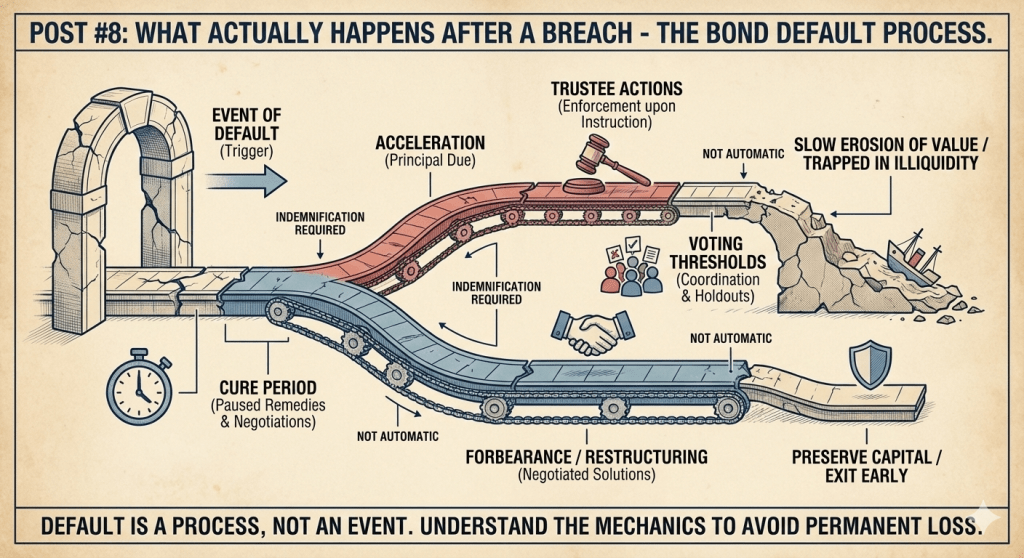
In reality, default is a process, not an event. It unfolds through notices, cure periods, voting thresholds, trustee actions, and legal constraints — all pre-defined in the indenture.
Understanding how default actually works often determines whether a bondholder:
- Exits early
- Preserves capital
- Or gets trapped in a slow erosion of value
This post explains what really happens after a breach — not in theory, but in contractual reality.
1. What Is an Event of Default? (EOD)
An Event of Default is a contractually defined trigger that allows bondholders to enforce remedies.
Not all problems are defaults.
Not all defaults are immediately enforceable.
Indentures distinguish between:
- Events of Default
- Events of Potential Default
- Technical breaches with cure rights
Understanding that distinction is critical.
2. The Most Common Events of Default
A. Payment Default
Failure to:
- Pay interest
- Repay principal
- Make sinking fund payments
These are usually:
- Subject to a short grace period (5–30 days)
- Clear and unambiguous
Payment defaults are the strongest triggers.
B. Covenant Default
Failure to comply with:
- Negative covenants
- Affirmative covenants
- Reporting requirements
These often include:
- Notice requirements
- Cure periods (30–90 days)
- Remedial actions
Covenant defaults rarely lead to immediate acceleration — but they signal deterioration.
C. Cross-Default/ Cross-Acceleration
Triggers default if:
- Other material debt defaults or accelerates
Strong versions:
- Low dollar thresholds
- Broad debt definitions
Weak versions:
- High thresholds
- Exclusions for subsidiaries or secured debt
This determines how quickly distress spreads.
D. Bankruptcy or Insolvency
Includes:
- Bankruptcy filings
- Insolvency proceedings
- Assignment for benefit of creditors
These typically trigger automatic acceleration.
E. Judgment Defaults
Large court judgments not paid within a specified period can trigger default.
Often overlooked but critical in litigation-heavy industries.
3. Cure Periods: Why Defaults Are Not Immediate
Most defaults include a cure period:
- Time allowed for the issuer to fix the breach
- Prevents technical defaults from causing chaos
Examples:
- Late filing of financials → 60 days to cure
- Covenant breach → 30–90 days to restore compliance
During cure periods:
- Bonds may sell off
- But legal remedies are paused
Sophisticated investors watch cure clocks, not headlines.
4. Acceleration: When Principal Becomes Due
Acceleration means:
The entire outstanding principal becomes immediately payable.
Acceleration is not automatic in most cases.
How Acceleration Occurs
- Typically requires a vote (often 25%–50% of holders)
- Initiated through the trustee
- Can be reversed if defaults are cured
Why Acceleration Is Rare
- It can force bankruptcy
- It reduces restructuring flexibility
- It may destroy residual value
Bondholders often prefer negotiation to acceleration.
5. The Trustee: Pwer, Limits, and Reality
Bondholders do not act individually.
They act through a trustee.
What the Trustee Does
- Receives default notices
- Represents bondholders collectively
- Enforces remedies upon instruction
- Manages legal actions
What the Trustee Does NOT Do Automatically
- Monitor issuer behavior proactively
- Declare defaults without direction
- Act unless indemnified
Trustees are administrative agents, not activist defenders.
Trustee Indemnification Clause (Critical Detail)
Most indentures require:
Bondholders to indemnify the trustee against costs before action is taken.
This means:
- Small holders lack influence
- Action requires coordination
- Delay is common
Default enforcement is slow by design.
6. Holder Voting Thresholds: Who Controls the Outcome
Indentures specify voting thresholds for:
- Acceleration
- Waivers
- Amendments
Typical thresholds:
- 25% → Declare default / accelerate
- 50%+ → Direct trustee actions
- 66⅔% → Amend core terms
This creates:
- Coordination problems
- Holdout power
- Strategic behavior among creditors
Bondholders do not move as one unit.
7. Why Many Defaults don’t Lead to Immediate Recovery
Even after default:
- Interest may continue to accrue
- Negotiations can last months or years
- Recoveries depend on asset value, not legal rights
Common outcomes:
- Forbearance agreements
- Amend-and-extend deals
- Debt exchanges
- Out-of-court restructurings
Default ≠ cash recovery.
8. Real-World Pattern: The Slow Default
Many distressed credits experience:
- Covenant breach
- Cure extension
- Waiver negotiations
- Rating downgrade
- Price decline
- Exchange offer
- Eventual restructuring
Bondholders who understand the process:
- Exit earlier
- Preserve capital
- Avoid illiquid endgames
Those who don’t:
- Hold too long
- Rely on legal myths
- Suffer permanent loss
9. Practical Default-Section Checklist
When reading the EoD section, identify:
- What constitutes default
- Grace periods
- Cure rights
- Acceleration thresholds
- Trustee obligations
- Indemnification clauses
- Voting requirements
- Amendment mechanics
Ask yourself:
How fast can I act — and how hard is it to act?
10. Value Investor Interpretation
Default is not a cliff.
It is a slope.
The bond indenture determines:
- How steep the slope is
- Who controls the descent
- Whether exits exist before free fall
Value investors win in credit by:
- Anticipating stress
- Respecting structure
- Acting early — not legally, but economically
Conclusion
Most bond investors lose money not because they misunderstand yield but because they misunderstand process.
Events of Default do not guarantee protection.
They only define who may act, when, and at what cost.
If you don’t know those rules, you are not protected you are merely hopeful.
 BargaInvest Capital
Leave a comment