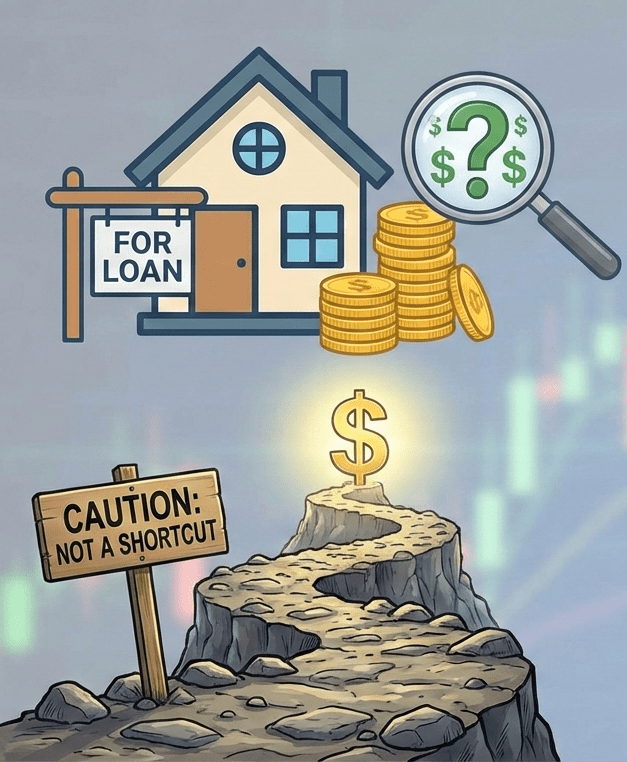
Every few months, social media is flooded with the “billionaire riddle”:
“Billionaires borrow against their homes to invest. Why aren’t you doing the same?”
It sounds clever, but let’s examine it with the logic and patience Warren Buffett and Charlie Munger would use.
1. Understand the Asset You Are Leveraging
Your home is not just a number on a spreadsheet — it is your financial safety, your place to live, and your primary wealth store.
The Scenario:
- Home value: $270,000
- Equity: 20% → $54,000
- Borrowed amount: $50,000 (HELOC) at 6% interest
The First Question: What happens if the investment doesn’t go as planned?
- If the market rises 10%: You earn $5,000, pay $3,000 interest → Net gain $2,000.
- If the market drops 30%: You lose $15,000 and still pay $3,000 interest → Net loss $18,000.
(Note: Even if the interest is tax-deductible in your jurisdiction, the minor tax savings rarely outweigh the danger of a 30% market loss combined with a leverage squeeze.)
The interest cost is real and recurring, and your home is the collateral. You are risking permanent shelter for a temporary, speculative gain.
2. Time Alone Doesn’t Remove Risk
A common argument is, “I’ll just hold it for 25 years — it will pay off.”
Historically, the S&P 500 returns ~8–10% per year. However, leverage magnifies volatility. An early 30% drawdown, even if temporary, can wipe out years of potential growth because the debt stays fixed while your capital shrinks.
The Leverage Trap (Sequence of Returns Risk):
| Scenario | Market Return Year 1–5 | Year 6–25 | Borrowing Rate | Ending Value | Lesson |
| Stable Growth | +9% | +9% annually | 6% | $356,154 | Leverage works only if markets are calm. |
| Early Crash | -30% | +9% | 6% | $121,154 | Early losses dominate long-term growth. |
| Home Drop + Crash | -30% | +9% | 6% + home -20% | $102,818 | Compound risk of home + market is severe. |
Important Note on Math: The calculations above assume interest payments (6%) are withdrawn directly from the investment balance annually. This creates a “cash drag” that severely stunts compounding during a downturn. If you pay interest out of your salary instead, your portfolio looks better, but your personal monthly cash flow takes a hit.
Observation: Time smooths ordinary investments, but leverage introduces risk that time does not erase.
3. The “Call Risk”: The Nightmare Scenario
There is a structural risk that social media influencers ignore: The Bank Freeze.
In a recession, stock markets often drop at the same time home values soften.
- If your home value drops, the bank can view you as “higher risk.”
- They have the right to freeze your HELOC or reduce your credit limit without warning.
- If you used that money to buy stocks that also dropped, you are now squeezed. The bank may demand repayment (a margin call on your house) exactly when you have no cash and your stocks are down.
Billionaires mitigate this with massive cash reserves. The average homeowner does not have that luxury.
4. Why This Works for Billionaires (And Not Me & You)
Billionaires are not “smarter investors” in a mystical sense. They operate under conditions the average homeowner cannot:
- Diversification: Their losses in one asset are buffered by dozens of others.
- Cheap, Structured Leverage: They use Pledged Asset Lines (PALs) with wholesale interest rates, not retail HELOCs tied to higher Prime rates.
- Liquidity: They hold cash reserves to handle drawdowns without stress.
- Professional Risk Management: Daily oversight and hedging strategies.
Replication by a homeowner with a single condo and a $50k HELOC is not comparable—it is a category error.
5. The Buffett-Munger Lens: Margin of Safety
Buffett and Munger insist: Never risk your permanent capital for temporary gain.
Borrowing against your home violates this principle — it risks your permanent capital (your house) for a speculative return. Leverage is a tool, not a shortcut. Without diversification, liquidity, and control over risk, it’s just gambling.
The Simple, Intelligent Alternative
- Invest your own cash gradually in broad markets.
- Use tax-advantaged accounts to compound safely.
- Pay off high-interest debt — the “return” here is guaranteed.
- Let time work without leverage and unnecessary risk.
Bottom Line
The “billionaire riddle” is seductive but misleading. Using home equity to invest is speculation, not investing. The intelligent approach is to preserve capital, understand your risks, and avoid strategies that look good on social media but are fragile in reality.
Leverage magnifies outcomes. Only use it if you can afford to be wrong without losing your home. Most homeowners cannot.
 BargaInvest Capital
Leave a comment