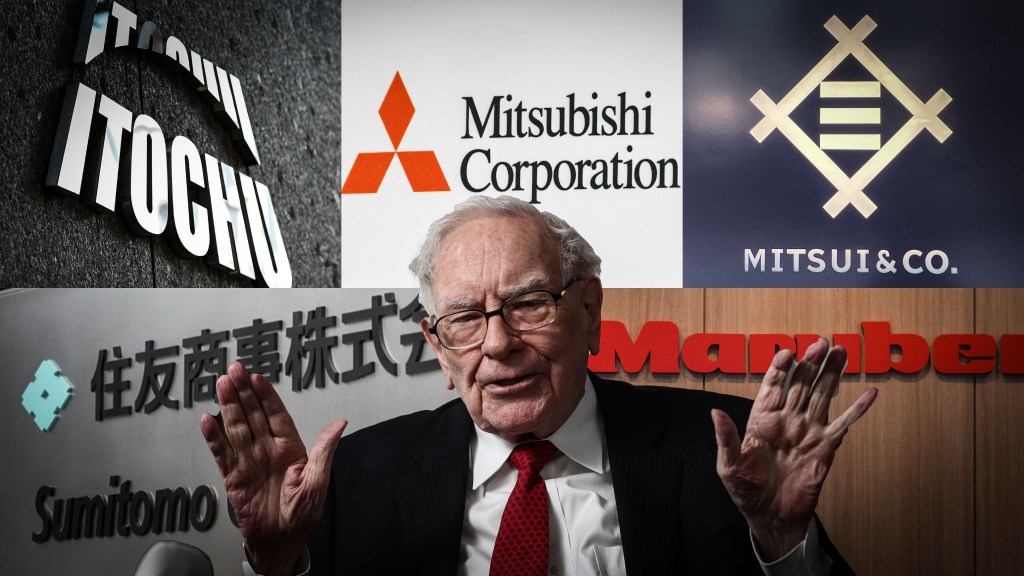
More than an investor, he is a teacher, and his approach to business, ethics, and patience is a lesson in itself.
When Buffett invested in Japan’s five major trading houses Mitsubishi Corporation, Mitsui & Co., Ltd., Itochu Corporation, Marubeni Corporation, and Sumitomo Corporation — the world was surprised. To Buffett, it was simple logic. He was doing what he has always done: identify businesses with durable competitive advantages, assess their intrinsic value, acquire them with thoughtfully structured capital, and hold patiently.
What makes this even more remarkable is his integrity. Buffett made it clear to the trading houses that he would not increase his stake without their permission. This wasn’t just smart investing; it was a demonstration of trust and respect, reflecting the principles that guide his every decision.
This was not a bet on hype or trends. It was a masterclass in asymmetry, patience, and disciplined thought a lesson in seeing value where others see stagnation and structuring opportunities to minimize risk while maximizing insight.
Understanding Buffett’s Rationale — Why These Businesses
For decades, Japan’s markets were written off: low or negative inflation, near-zero interest rates, and large parts of the stock market stagnant. Many investors looked away. Buffett looked closer.
He gravitated toward the five major Japanese trading houses because they had attributes he prizes:
- Diversified global operations: deeply embedded across commodities, logistics, infrastructure, food, and industrial trade — not dependent on speculative technology.
- Strong cash flows and capital discipline: attractive earnings yields and reliable dividends.
- Durability over glamour: understandable, resilient, and entrenched, rather than flashy or speculative.
- Undervalued relative to opportunity: Buffett recognized the earnings yield as compelling and rare.
- Alignment of business and investor interests: returning capital, improving governance, and acting consistently with long-term shareholder value.
Buffett treated these trading houses like mini versions of his ideal business: steady, resilient, understandable. In his mind, the “moat” was structural diversified reach, disciplined capital deployment, and the ability to harvest cash flows over time.
Structuring the Investment Thoughtfully
Buffett invested roughly $13.8 billion in total. He borrowed most of the amount at extremely low interest in yen, roughly 0.5%, which limited his personal equity exposure. The dividends alone covered the interest about 16 times over a level of cash-flow safety that’s almost unheard of.
Scenario A — 20% Equity
- Equity invested: $2.76 billion
- Debt: $11.04 billion at 0.5% → $55 million annual interest
- Dividend yield (~8%) → $1.104 billion annual dividends
- Net cash flow from dividends → ~$1.049 billion/year
- Return on equity from dividends alone → ~$1.049B ÷ $2.76B ≈ 38% annually
Scenario B — 0% Equity (Conceptual)
- Fully financed
- Positive cash flow from dividends after interest, with effectively no equity at risk
Even with just 20% equity, the dividends alone generated massive returns. Add capital appreciation (~70% over four years), and the compounded return on equity is roughly 48% CAGR about 4.8× the original equity in four years.
The brilliance is in the asymmetry: a tiny cost of capital (0.5% interest) versus dividends that were 16× that cost, creating enormous margin of safety and an almost guaranteed return all while leaving upside open from capital appreciation.
Comparing with NVDA and the S&P 500
| Investment | Price / Value Start → End | Compounded Return (CAGR) | Risk Profile |
|---|---|---|---|
| Buffett’s Japan Trades (20% equity) | $13.8B → $23.5B + dividends | ~48% CAGR | Limited downside; dividends covered interest ~16×; minimal equity at risk |
| Buffett’s Japan Trades (0% equity) | Conceptual fully financed | Effectively very high | Illustrative; minimal equity at risk; conceptually nearly risk-free |
| NVIDIA (NVDA) | ~$60 → ~$202 | ~32% CAGR | High risk; narrative-driven; large drawdowns possible |
| S&P 500 | 3,000 → 4,400 | ~10.2% CAGR | Moderate risk; diversified, but no asymmetric edge |
NVDA’s rise is impressive but depended on assumptions about AI growth and investor enthusiasm. Even a 50% drawdown would drastically reduce returns. By contrast, Buffett’s Japan trades delivered high compounded returns with structured safety: dividend coverage 16× the interest cost, low-cost financing, and selection of resilient businesses with durable moats. The asymmetry huge potential upside, very limited downside illustrates Buffett’s disciplined approach.
Looking Forward: 10-Year Projection
Buffett’s dividends reinvested could grow the original $2.76 billion equity by roughly 10× over the next ten years, even if the trading-house stock prices increase only modestly.
By comparison, NVDA, currently trading around $202, would need to double to ~$370/share over the same period to match a base-case scenario. That upside relies entirely on price appreciation and carries much higher risk: regulatory changes, competition, and market sentiment all threaten the outcome.
Buffett’s approach illustrates the elegance of asymmetric risk: meaningful upside, limited downside, and time as a powerful ally. The trade is a masterclass in structuring investments so that patience and careful analysis compound advantage steadily.
Lessons from Buffett’s Approach
- Focus on business quality and cash flow, not hype
- Match currency, financing, and investment to reduce mismatch
- Build asymmetric risk: limited downside, meaningful upside
- Use time as your ally
- Make decisions grounded in process, not speculation
Final Thought
The beauty of this investment lies not in the headlines or the returns, but in the elegance of the thinking behind it. Buffett identified deeply rooted businesses, structured the deal to limit risk and maximize optionality, and patiently let time work its magic.
As someone who studies him closely, I try to learn from his process and emulate his discipline, but there is a quiet genius here that is simply beyond me. This is investing as an art thoughtful, patient, and profoundly logical. I am happy to have witnessed it in action.
 BargaInvest Capital
Leave a comment